

Smart carts and shopping agents won’t kill restaurants. But they will change how diners decide what is “worth it.”
Restaurant owners are tired of being told that every new technology will “transform the industry.” Most of it does not. A QR menu does not fix weak margins. A chatbot does not save a bad guest experience. A loyalty app nobody uses is just another monthly software bill.
But AI in grocery is different.
Not because smart carts are impressive. Not because an AI assistant can suggest a recipe. And not because supermarkets suddenly became more innovative than restaurants.
It matters because grocery AI is moving closer to the diner’s decision point: what should I eat, what should I buy, what is worth spending money on, and what can I skip?
That should get every restaurant operator’s attention.
FMI and NIQ’s 2026 grocery research says online grocery now drives nearly three-quarters of total grocery dollar growth, with U.S. online grocery sales projected to reach $452 billion by 2028. The same research points to AI tools that could reshape planning, discovery, and low-consideration purchasing — the everyday decisions shoppers barely think about. NRF’s 2026 retail outlook says AI is moving into smart consumer agents, autonomous supply chains, personalization, and operational efficiency.
For restaurants, the question is not, “Should we use AI?”
That is too shallow.
The better question is: what happens when grocery becomes better at helping customers avoid restaurants on the nights when restaurants are not clearly worth it?
The Real Threat Is Not Grocery. It Is the Default Meal
Most restaurants do not lose customers because someone wakes up excited to cook lentils at home.
They lose customers in the gray zone.
The tired Tuesday. The family trying to save money. The office worker who does not want to spend $19 on a mediocre lunch. The couple who would go out, but parking, delivery fees, service charges, and menu prices make the decision feel heavier than it used to.
That gray zone is where grocery AI becomes dangerous.
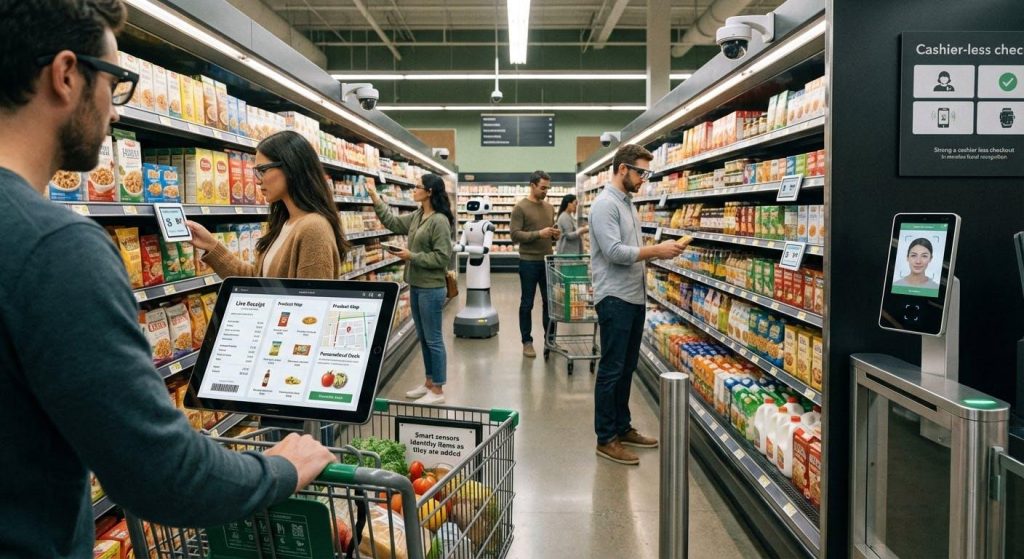
Imagine a customer opens a grocery app and says, “Plan three quick dinners under $60, high protein, no pork, with leftovers for lunch.” The assistant builds the basket, applies loyalty discounts, swaps out expensive items, and reminds them they already have rice at home. That is not science fiction anymore. NIQ describes agentic commerce as AI agents taking over tasks such as searching, comparing, and purchasing, including examples like restocking weekly groceries based on preferences, purchase history, inventory, and discounts.
Now compare that with the restaurant experience many customers face: search Google, scan reviews, compare menus, wonder if prices are outdated, check if delivery fees are outrageous, and hope the food arrives warm.
That is the tension.
Restaurants are not just competing against other restaurants. They are competing against a smarter, more convenient version of “eating at home.”
Restaurants Are Already Under Pressure. AI Just Raises the Bar
This is happening at a bad time for operators.
The U.S. restaurant industry is still dealing with a margin squeeze. The National Restaurant Association’s 2026 report says more than 9 in 10 operators cite food, labor, insurance, energy, and swipe fees as significant challenges, and 42% of operators reported their restaurant was not profitable the previous year. In Europe, operators continue to face their own version of the same problem: high labor costs, energy pressure, food inflation, tighter regulation, and customers who still want value but do not want the experience to feel cheap.
This is why bad advice hurts.
“Just post more on Instagram” is not a strategy.
“Add AI to your restaurant” is not a strategy.
“Start a loyalty program” is not a strategy if nobody joins, nobody returns, and nobody on your team has time to manage it.
Operators need to understand the grocery AI shift in practical terms. AI is not simply a new marketing channel. It is becoming a decision filter. It will influence what customers discover, compare, buy, repeat, and ignore.
If your restaurant is hard to understand, hard to find, hard to order from, poorly reviewed, inconsistent across platforms, or too vague about value, AI-powered discovery will not magically rescue you. It may bury you.
Low-Consideration Dining Is Most Exposed
Not every restaurant is equally vulnerable.
A special occasion steakhouse is not competing with a smart cart in the same way a lunch spot is. A destination omakase counter does not need to panic because a grocery app recommends salmon. A beloved neighborhood bakery with a line out the door has a different kind of demand.
The exposed category is low-consideration dining.
That includes weekday lunch, family takeout, casual delivery, office catering, meal-prep adjacent concepts, and restaurants whose main value proposition is convenience.
If customers see you as “food when I don’t feel like cooking,” you are standing directly in the path of grocery AI.
That does not mean you are doomed. It means your offer has to become sharper.
A generic pasta bowl is vulnerable. A clearly positioned “20-minute family dinner bundle for four” is stronger.
A random salad menu is vulnerable. A “high-protein lunch under 700 calories, ready in 8 minutes” is stronger.
A delivery listing with 94 menu items is vulnerable. A tight, profitable, repeatable menu built around customer missions is stronger.
Grocery AI is teaching customers to think in outcomes: budget, speed, health, convenience, preference, household planning. Restaurants should learn from that.
The Smart Alternative: Build Around Customer Missions
Most restaurant marketing is still built around the operator’s perspective.
“We have new specials.”
“Come try our brunch.”
“Order now.”
That is fine, but it is not enough.
Grocery AI is being built around customer missions: feed the family, save money, eat healthier, avoid waste, discover something new, restock essentials, plan the week.
Restaurants should borrow that logic.
Instead of only promoting menu items, build offers around real use cases:
The exhausted parent: a family bundle with clear portions, pickup timing, and no surprise fees.
The office manager: catering packages that are easy to approve, easy to reorder, and reliable by 11:45 a.m.
The health-conscious regular: a set of high-protein, lower-calorie meals that do not taste like punishment.
The value-seeking couple: a weekday dine-in offer that protects margin through smart menu engineering instead of lazy discounting.
The mistake is discounting everything and calling it value.
The smarter move is to package value. Use bundles, limited menus, off-peak offers, loyalty perks, and add-ons that increase perceived value without training customers to wait for coupons.
Value does not mean cheap. It means the customer understands why the spend makes sense.
Your Menu Needs to Be Legible to Humans and Machines
This is the part many operators will ignore, and they will pay for it.
AI assistants need clean information. So do customers.
If your menu is inconsistent across your website, Google Business Profile, delivery apps, reservation platforms, and social pages, you are creating friction. If your best items are buried under vague names, missing descriptions, poor photos, or no dietary tags, you are making it harder for both people and algorithms to recommend you.
This matters more as discovery shifts from “restaurants near me” to more specific prompts:
“Best halal-friendly lunch near me under $20.”
“Good restaurant for a client dinner with vegetarian options.”
“Family-friendly Italian takeout open now with gluten-free choices.”
“Where can I get a healthy high-protein meal nearby?”
If your digital presence cannot answer those questions clearly, you are not in the consideration set.
Operators should treat menu data like infrastructure, not admin work. Clean up item names. Add useful descriptions. Mark allergens and dietary preferences accurately. Keep hours current. Make pricing consistent. Upload real photos. Make ordering links obvious. Remove dead pages. Respond to reviews with substance.
This is not glamorous. It is how modern demand is captured.
Do Not Automate the Hospitality Out of the Restaurant
There is another trap here.
Some operators will look at grocery AI, panic, and try to automate every guest interaction. That is a bad read.
Restaurants are not grocery stores. A restaurant’s advantage is not just food. It is hospitality, energy, memory, taste, timing, atmosphere, trust, and human judgment.
Use AI for the back office before you use it to replace warmth.
Use it to forecast demand, analyze menu profitability, summarize reviews, identify repeat complaints, improve prep planning, draft local store marketing campaigns, segment customers, and clean up ordering data.
Be careful using it where guests expect care.
Nobody wants a robotic apology after a ruined anniversary dinner. Nobody wants a clumsy chatbot handling a serious allergy question. Nobody wants personalization that feels creepy.
Automation should remove friction. It should not remove responsibility.
The best restaurant tech disappears into the experience. It helps the team move faster, remember better, waste less, and serve with more confidence.
Delivery Apps Will Not Solve This for You
Delivery platforms can bring volume, but they do not automatically build a durable restaurant brand.
Many operators already know the ugly math: commissions, promotions, packaging costs, refunds, menu inflation, and customers who belong more to the app than to the restaurant. As grocery and retail AI become more personalized, restaurants that rely only on third-party marketplaces risk becoming interchangeable inventory.
That is a weak position.
The smarter approach is to use delivery apps as acquisition and convenience channels, not as the whole customer relationship.
Give first-time app customers a reason to order direct next time. Build a proper email and SMS list. Use bounce-back offers that protect margin. Create direct-order bundles that are not available everywhere. Make pickup meaningfully better. Train staff to mention loyalty without sounding desperate.
You do not need to abandon delivery apps. But depending on them blindly is lazy strategy.
What Restaurant Owners Should Do Now
Do not start with expensive AI tools.
Start with the basics that AI will make more important.
Audit how your restaurant appears across Google, Apple Maps, delivery apps, reservation sites, Tripadvisor, Instagram, TikTok, and your own website. Search like a customer, not an owner. Look for broken hours, weak photos, outdated menus, missing dietary details, confusing ordering paths, and review themes you keep pretending are isolated incidents.
Then tighten your offer.
Which occasions do you actually win? Weekday lunch? Date night? Family takeout? Catering? Late-night? Healthy bowls? Premium celebration dining?
Stop trying to be everything. Grocery AI will reward clarity. So will customers.
Next, build three or four high-margin customer missions into your menu and marketing. Not gimmicks. Real reasons to choose you.
Finally, use AI internally where it can save management time. Have it analyze reviews monthly. Compare item margins. Draft local campaign ideas. Summarize competitor positioning. Turn catering inquiries into faster responses. Help managers spot patterns before they become expensive problems.
That is practical AI.
Not shiny. Useful.
The Takeaway
AI in grocery will not replace restaurants. People still want to go out. They still want to be served. They still want atmosphere, indulgence, celebration, convenience, and the small luxury of not cleaning the kitchen.
But the weak middle is going to get squeezed.
If a restaurant is forgettable, overpriced, inconvenient, inconsistent, or unclear, grocery AI gives customers one more reason to stay home. If a restaurant is sharp about its occasions, clean with its digital presence, disciplined with its menu, and serious about hospitality, the shift can actually help it stand out.
The future is not restaurants versus AI.
It is restaurants with a clear reason to exist versus restaurants hoping customers keep choosing them out of habit.
And habit is getting easier to break.